Espressif Engineering

Help your Agent work through ESP engineering issues with a clear process, more complete analysis, transparent reasoning, and actionable recommendations.

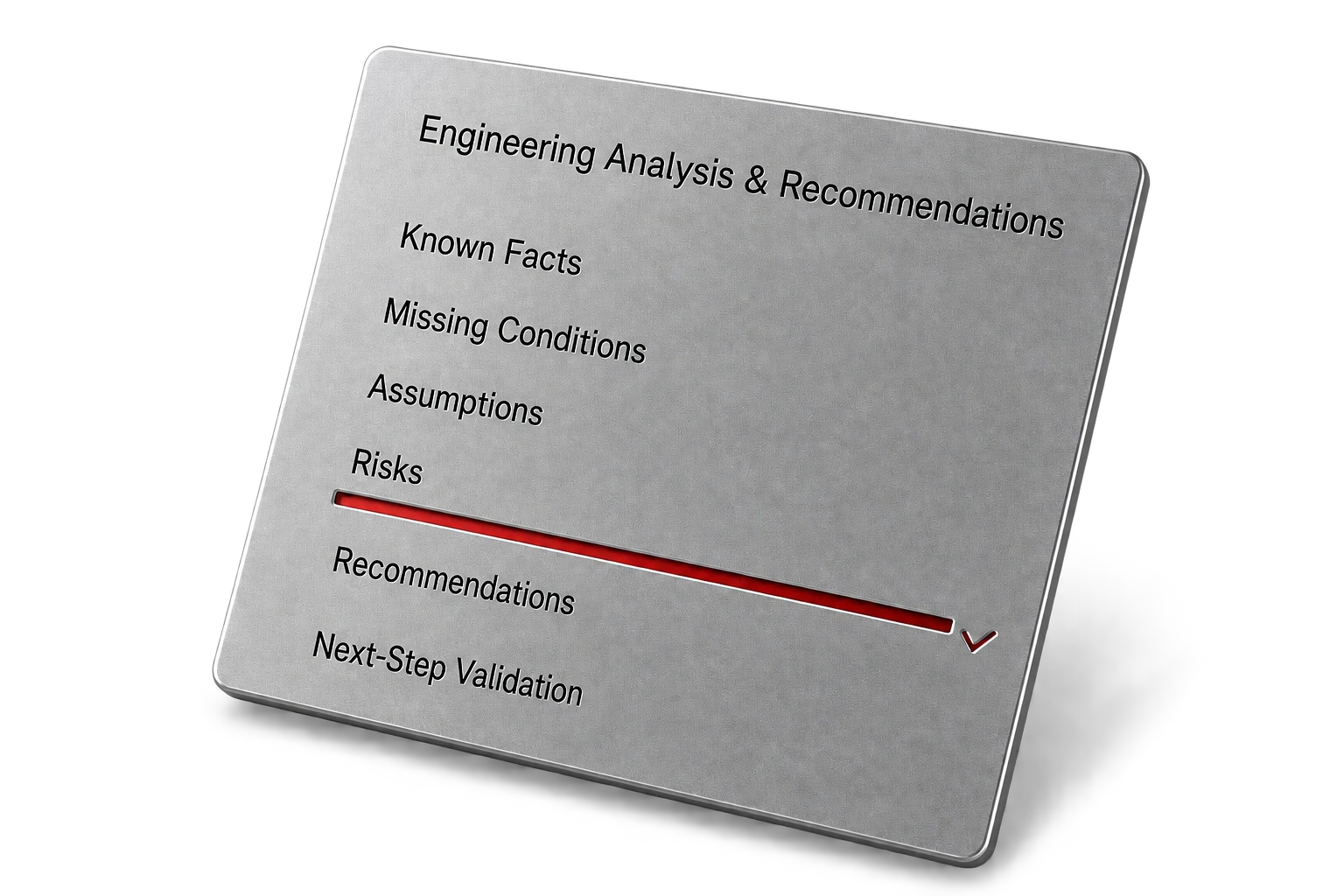
Precision aluminum decision plate engraved with categories for engineering analysis and recommendations

Value and real-world case

Espressif Engineering helps users identify missing information and high-risk items earlier, reducing biased decisions, repeated clarification, and trial and error. The Matter gateway selection case below shows how that value appears in an Agent's actual response.

Matter gateway evaluation: the customer had preselected ESP32-S31 for a 24/7 Matter gateway planned for mass production in 2027, with RSA Secure Boot, a 7-inch SPI display, dual-band Wi-Fi, and OTA requirements.

Decision stage
Without Espressif Engineering
With Espressif Engineering

Where the analysis startsStarting point

Look for a feasible solution around the preselected S31.

Recheck every constraint instead of treating a single S31 as the default production solution.

How to choose the system architectureSystem architecture

Drop 5 GHz, keep S31, and implement Matter–Zigbee on one chip.

When dual-band Wi-Fi is mandatory, prioritize C5 + H2 while comparing S3 + H2 and a standalone S31.

How to move toward productionPath to production

Keep E22 plus an external host as an alternative.

Add checks for RSA, display memory, integration cost, and production status.

Conclusion

For the same selection question, using Espressif Engineering changes more than the Agent's final recommendation. It also changes whether it rechecks requirements and initial assumptions, and whether architecture trade-offs, stability, potential risks, alternatives, and production conditions are included in the full decision.

FIG. 02-1
About this case

This case comes from an anonymized real consultation in Espressif's official Chatbot. Both comparisons used the same Agent, model configuration, input, and context, and both could call Espressif Documentation MCP. The only difference was whether Espressif Engineering was connected.

The page condenses the actual outputs while preserving their main judgments and conclusions.

The case conclusion is based on this project's requirements and the product information available at that time. It is not general selection advice for other projects; use current official documentation and your own project constraints for a specific decision.

Engineering capabilities and test results

Chip selection

Example question

“Which chip or module best fits these connectivity, memory, interface, power, and production constraints?”

What you receive

Candidate chips or system architectures, trade-off rationale, potential risks, alternatives, and checks before production.

Environment setup

Example question

“Help me set up ESP-IDF on a clean computer and validate the toolchain.”

What you receive

Reproducible installation steps, version and dependency checks, environment configuration, and an initial validation build.

Hardware review

Example question

“Review this schematic and PCB for power, boot, RF, and layout risks before fabrication.”

What you receive

Itemized findings for the actual chip or module, with evidence, risks, and follow-up checks organized by severity.

Wi-Fi troubleshooting

Example question

“The device disconnects intermittently. What evidence should I collect first?”

What you receive

A troubleshooting path organized by protocol, RF, network, and system layers, plus the logs, code, configuration, and validation steps still needed.

Security troubleshooting

Example question

“How should Secure Boot, Flash Encryption, or NVS Encryption be configured, and how do I troubleshoot boot, update, or reflashing failures after enabling them?”

What you receive

Assess the current security state and recovery boundary using the chip, ESP-IDF version, sdkconfig, eFuse state, logs, and key status, then provide configuration, flashing, recovery, and validation steps.

BLE troubleshooting

Example question

“A BLE device cannot be discovered, fails to connect, disconnects randomly, or misses throughput and latency targets. What should I check first?”

What you receive

Use the chip or module, ESP-IDF version, host stack, logs, error codes, and any needed over-the-air capture to separate hardware from software causes and identify the most likely direction, missing evidence, and next validation step.

Engineering issue workflow

After connecting Espressif Engineering, the Agent matches the issue to the relevant engineering workflow and works through the following stages.

  1. Read the issue and context

    Read the goals, symptoms, versions, logs, code, schematics, PCB files, configuration, and known constraints supplied by the user.

  2. Match the workflow

    Match and load the engineering workflow for the issue type.

  3. Fill gaps and assess risks

    Identify missing information, separate facts from assumptions, and compare trade-offs and items that still need validation.

  4. Verify official documentation

    When versions, specifications, support status, or interface capabilities matter, retrieve and verify Espressif's official documentation.

  5. Form recommendations and a validation plan

    State the facts, missing conditions, assumptions, risks, recommendations, trade-off rationale, and validation plan.

Service dependencies and setup

Espressif Engineering uses Espressif Documentation MCP Server to verify current official documentation while following an engineering workflow. Connect and authenticate both services separately in the same AI client.

Espressif Documentation MCP Server

Retrieves current official Espressif documentation to support fact-checking and source references in the workflow.

Espressif Engineering MCP Server

Provides analysis steps, prerequisites, risk checks, and decision criteria organized for different ESP engineering issues.

Supported AI clients

  • Cursor
  • VS Code
  • Claude Code
  • OpenAI Codex
  • OpenCode
  • Antigravity

Setup and usage FAQ

Do I need to install and manage Skills locally?

No. After Espressif Engineering is connected, the AI client retrieves the relevant content from the service for each task. You do not need to maintain Skill files or synchronize updates yourself.

Can it handle engineering issues not listed here?

The page lists the engineering capabilities currently available from Espressif Engineering and covered by internal testing. For an unlisted issue, the Agent can still use Espressif Documentation to query official material, but there may be no corresponding Engineering workflow and its response is outside the scope of the test results shown here.

Why do the two services require separate authentication?

Espressif Engineering and Espressif Documentation are independent services, so each must be connected and authenticated separately. Your AI client opens the relevant authentication interface.

Does it replace engineering review?

No. It supports early analysis, information gathering, and risk discovery. Production, certification, and other high-risk engineering decisions still require physical testing and review by an engineer.

How can I send feedback about Espressif Engineering?

Use the to report setup issues, answer-quality problems, capability gaps, or ideas for new capabilities.

Help us improve our engineering capabilities